Welch’s White

This batch was made from 12 cans of Welch’s White Grape Juice (About $30). The yeast is Lalvin 71B-1122, which is supposed to be good for preserving fruit flavors. It also might not tolerate high alcohol levels, so there might be residual sugar after fermentation is complete. I will be using some amount of time with a yeast starter to make sure fermentation starts off on the right foot.

I am making this wine because it sounded interesting and because I wanted another wine to blend my crabapple wine with due to its overly sour/tannin flavor. Though, I might change my mind. The crabapple is still clearing in the carboy, so in a week or two I’ll taste test it again. Who knows? I might find it to be just fine by itself. Regardless, this experiment with cheaper ingredients might prove to produce a pleasant everyday wine.

Continue reading “Welch’s White”

New Gcolor2 Icon Art

As a web designer I find application-independent color picking tools extremely useful. I am often working with an array of applications simultaneously and the color I want to identify/dissect/define can be present anywhere on my screen. Being tied to the color picker from either Photoshop or Gimp is very limiting. Usually their “dropper” tool will only work within their own environments and windows. This makes identifying colors that appear on websites impossible without a standalone color picking application (unless you use something like firebug to see the color’s identity in the sourcecode/dom).

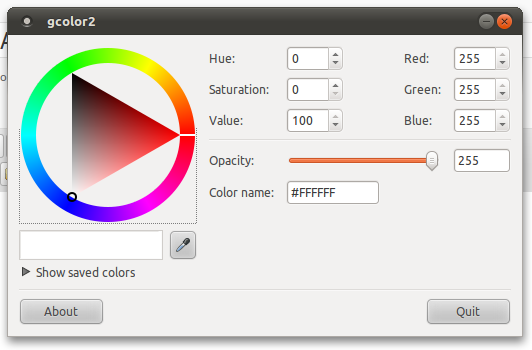
Gcolor2 is an excellent and simple little tool for web designers and developers running Linux. It has a dropper that can select a color from anywhere on screen and it describes each color in hexadecimal as well as HSV and RGB parameters. You can even keep a list of saved colors if would like.

However, the one shortcoming of the application is its bronze-age icon. It looks like it would be right at home on any ’90s-era desktop. See for yourself:

Needless to say, it looks awkward in the context of any contemporary desktop. It also lacks a nice clean edge, giving it jagged silhouette.  For this reason I opened up  Inkscape one night and created a new icon for Gcolor2. I really think the “drawn with a crayon” look was a ’90s style, so I abandoned that approach and recreated the tri-color cube as a more contemporary and clean-edged glowing box:

I think this a good solution. It’s not a complete departure from the original design but it is a refresh that will hopefully look great on the latest desktop systems. I have tried to submit it to the Gcolor2 project, but there hasn’t been an update since 2005 and none of the developers seem to have time to respond to my proposed new artwork. Today I submitted a patch and included the new artwork as a PNG and SVG files. You can certainly go there to get them, but you can also download the files here if you’d like to update your own desktop:

Download my 2010 version of the Gcolor2 icon as SVG

Another great application for working with colors in Linux is called Agave. It generates color schemes based on various color relationships like complementary, triadic, tetradic and analogous. Just give it one color and it will give you other colors according to the relationship type you specify. Fortunately it already has a very nice icon!

Sauvignon Blanc

This batch was made from a kit of Winexpert Selection International Series: Chilean Sauvignon Blanc ($107). The salesmen at my local winemaking supply shop (All Seasons Gardening & Brewing Supply) really talked-up the Winexpert International kits. The $40 difference didn’t phase me, so I thought it was worth a try. Especially since my wife and I so thoroughly enjoyed the last batch of Sauv. Blanc (we have already consumed the entire batch!).

I’ve also been reading up on yeast starters over at Jack Keller’s website (a great resource for home winemaking). Supposedly the longer it takes for your yeast to get up and running once its been introduced to the must, the more flavor you are losing. It makes sense, but I highly recommend reading Jack’s page to get the whole story.

With that said, I have decided to give using a yeast starter a try.

Continue reading “Sauvignon Blanc”

Yeast Starter

The following recipe is pulled directly from Jack Keller’s web page on Yeast Starters. He’s written an excellent page there that I highly recommend reading. However, the way he has written out the process of creating a yeast starter, in my humble opinion, needs a lot of rereading in order to be comprehended. On this page I have merely restructured his instructions in a traditional recipe format that I find easier to understand. Jack is apparently flooded with e-mails, so he’s hard to get a hold of. I hope he does not take offense that I am providing my rendition of his recipe here in case others might find it useful.

Ingredients/Equipment

  • 1 – 4 cup tupperware container with lid for yeast starter (larger is fine)
  • 1 – packet of active dry yeast
  • 1 cup of 100 – 105°F tap or spring water.
    The harder the water the better; do not use distilled water.
  • ½ cup of non-citrus, pre-sweetened fruit juice.
    Concord or white grape are good depending on the wine you are making.
  • 1 – 1 cup tupperware container with lid for juice (larger is fine)

Instructions

  1. In the first container combine yeast and water. Stir gently, cover and let sit.
  2. After 30 minutes check the yeast. If it appears to be active (not dead) cover and let sit.
  3. While that sits set out a ¼ cup of fruit juice so that it will aclimate to the same temperature as the yeast starter.
  4. After 3 hours add the ¼ cup of juice to the yeast starter, cover and let sit in a warm place. Set out another ¼ cup of juice.
  5. After 4 hours check viability, add the second ¼ cup of juice to the yeast starter, cover and let sit in a warm place.
  6. After another 4 hours the yeast starter is ready to add to the must.

Cabernet Franc

This batch was made from a kit of Winexpert Selection Original Series: Cabernet Franc ($110 but I got it on sale for $77!) and French Oak Cubes (Heavy Toast) ($8). I’ve been disappointed with my homemade red wines so far. Some of my problems are due to bad corks, some due to cheap wine kits. Some of my disappointment, I fear, is due to the limitations of the home winemaking tool kit. I highly recommend using high-quality corks for wines that you plan to store for more than three months. I also highly recommend buying $100+ red wine kits if you want a respectable red wine. So far the Winexpert Selection Original Series:Luna Rossa is very promising.

As you can see, with this batch I’m going to experiment with simulating the oak-barrel aging process by way of soaking oak cubes in the finished wine. I plan to add the oak cubes to the wine once it is almost completely clear. Once added I will keep the wine in bulk storage with the cubes for at least two months.

This kit, like other red wine kits, came with some packets of oak chips/sawdust. They are intended to be added to the initial must. I am sure this adds a little oak flavor to the wine, but it seems like the oak chips get filtered out as the must is transferred to the secondary fermenter. So the oak chips are not in contact with the wine for very long. The packaging on these oak cubes states that they should be left in contact with the wine for at least eight weeks. Logically I can see how this would simulate storing the wine in oak barrels. We’ll see.

Continue reading “Cabernet Franc”

Add Bulk File Renaming to Apple’s OSX Finder.app

Today at work I was asked how to rename multiple JPEG files on a Mac. This individual was apparently able to accomplish this amazing feet with very little effort on a Windows system. (Every time I hear someone say how easy Windows makes something my stomach turns.) I used to have an AppleScript that did just that, but I have since lost track of that file. So I looked to the internet. Surely it’ll only take a few minutes to make this happen, right?

There is one free application available for renaming files (NameChanger) and there are several tutorials about using AppleScript and/or Automator.app. The DIY script and Automator options are okay for certain types of people, but the people that really need help will struggle to understand how to use these tools. What are all of the non-geek OSX users supposed to do?

Well, here’s another one of my small contributions to society. A free Automator.app-created workflow that will add the option ‘Rename Multiple Files’ to the contextual menu in Finder.app. Just select multiple files, right-click and select ‘Rename Multiple Files’ and away you go!

Here’s how to install this Rename Multiple Files tool:

  1. In the Finder navigate to /Users/yourname/Library/Services/
    [if “Services” doesn’t exist, create a new folder and name it likewise]
  2. Download the RenameMultipleFiles.zip, extract the contents onto your desktop (double-click in OSX)  and copy the file “Rename Multiple Files.workflow” to the previously mentioned “Services” folder.
  3. Open a Finder window with multiple files. Select all of the files. Right-click on the selected files. At the bottom of the contextual menu you will find an option titled “Rename Multiple Files”. (It may take a minute or two for this new option to become available on your contextual menu.)

Shortly after you click on “Rename Multiple Files” you will be presented with a small window and several options. To save a verbose explanation I have included screenshots of the options below.

This workflow was created on a Mac running OSX 10.6. It is dependent on Automator.app. It definitely works with other 10.6 machines, but if you are running some other version of OSX it may or may not work.

Please give me feedback about whether or not this is useful or if it doesn’t work at all. Thanks.

Tennessee Wild Blackberry

This batch was made from a kit of Winexpert Vintners Reserve: Piesporter ($63 but I got it on sale for $44!) and 10 lbs. of wild blackberries (free but for the afternoon I spent picking them in the beautiful Tennessee countryside, thanks to my friend Jerry). I was hoping to make a straight blackberry wine, but 10 lbs. just wasn’t enough. I had this piesporter kit waiting to be made and that’s how wacky wines are made!

Continue reading “Tennessee Wild Blackberry”

Lenovo G530 Touchpad (Trackpad) Disabled

Recently my wife was using my Lenovo G530 (running Ubuntu Linux) in the living room and somehow managed to disable the trackpad. She could not recall pressing anything unusual. This particular laptop has a little blue light that glows in between the two trackpad buttons with an icon indicating that the light means that the touchpad was disabled. Great, so the built-in feedback that the laptop had was working correctly, but how did we get the laptop in this state? At the time we had a friend over, so I just pulled out a spare mouse rather than attempt to solve the problem.

The next morning I expected that, upon restarting the laptop, the trackpad would be functioning correctly. There are many bugs in the computer world that can be resolved with a system restart. But that didn’t work this time. The touchpad continued to have no influence over the cursor on the screen.

I then proceeded to search the web for more information about this touchpad-disabling bug either associated to the Lenovo G530, to the particular version of Ubuntu that I was running or to a combination of the two. I found several listings but they mostly had to do with the touchpad being completely unavailable after a recent operating system install or upgrade. My touchpad had worked perfectly including horizontal and vertical scrolling until this recent change.

Well, after an hour or so of casually poking around the internet I discovered an important, but rarely noticed touch-sensitive button next to some touch-sensitive volume controls that I almost never use:

Sure enough, touching that quasi-button re-enabled the touchpad. My wife had apparently touched it accidentally when trying to increase the volume. All I could do was laugh at my stupidity. And be a bit delighted that Linux so completely supports the hardware on my laptop.

Boruvka Medovina

‘Boruvka Medovina’ is Czech for ‘Blueberry Mead’ (The ‘u’ should have a little ‘o’ above it, but WordPress can’t handle the character properly. I assure you that it will be correct on my label!). My surname is ‘Šimánek’, it’s printed on the bottle, so forgive me this one indulgence. I like the sound of it and since mead itself is pretty unusual for most folks, why not give it an exotic name? My dad might be amused also. He didn’t learn to speak English until he went to grade school, so I think he’s got a few Czech words still rolling around in his head. And, not being a grape wine drinker, he might actually enjoy this peculiar libation.

This batch was made from a 96 oz. can of Vintner’s Harvest Blueberry Fruit Wine Base ($40) and 16.5 pounds of Tennessee Honey ($65). I wanted to use local honey in order to get some kind of regional flavor. Some of the honey was ‘orange blossom’ and some of it was ‘wild flower’. I’m still wondering if the orange blossom honey was in fact harvested in Florida… oh well. The lady at the kiosk insisted that it was Tennessee honey. What’s important is that it isn’t some kind of blended grocery store honey.

I am using my own variation of a recipe called OMFG Blueberry Heaven by Dan Richardson. A bit of an experiment as usual. Dan’s instructions were a lot of fun and a huge help. I just made a few changes in quantity and used canned blueberries rather than fresh wild blueberries. I am also going to use the dry yeast packets that I am familiar with without doing any preparation. I have not spent much time dealing with the subtleties of yeast and yeast preparation, but that will come later after I’ve mastered all of the more basic practices of winemaking. Continue reading “Boruvka Medovina”

Art is Communication, Getting Yelled At by Art Is as Much Fun as Getting Yelled At by People

This post is the third of what I hope will be a series. My friend Adrian Hanft and I are going to try having an ongoing conversation about art and creativity. Initially it was going to be held via email, but we’ve agreed that it might be more interesting to have it via our blogs by way of the internet. With any luck it won’t end up being a bunch of ill-thought drivel.


We Need People to Take Art Seriously

Sometimes “art” feels irrelevant in the same way that I struggle with organized religion. People just prefer to ignore it. I think that is sad, because both art and Christianity have the power to rise above the mediocrity of everything else. It is much easier to ignore the meaningful things in life and embrace the “safe” stuff. As a result the kitsch rises to the top and things with substance get attacked – or worse yet ignored – because these things are uncomfortable. The people who create and have passion for them seem absurd because they have the guts to be different. People don’t have time to wrestle with deep thoughts when there are simpler ways to entertain themselves. Why would anyone want to stifle an endless stream of gratification by confronting things that aren’t easy to understand or appreciate?

—Adrian Hanft
from his post “Invisible Artwork: If We Ignore It Maybe It Will Go Away

I can relate to this perspective, but I also wonder about its validity. Sure, that’s the way things are right now, but was human culture ever any different?

I am quite sure that any time in the last 2010 years (at the very least) the ‘general public’ has had a consistently limited interest in any visual art that would not be considered ‘folk art’ or ‘kitsch’. Like public education, visual art as we know it has simply not been available to the general public for most of human history. There have always been objects and visual art in the home that fall under what we would call folk art. I think those items were focused on functionality and cultural meaning. Only the children had art objects that were purely for amusement. The act of selecting a painting or print to be hung on a wall in the home is something relatively new.

Only recently has the general public had the free time and money to attempt to emulate the rich by thoughtfully decorating their homes with the mass-produced copies of images that have already been defined as ‘good art’ by rich people in the past. Its as though they have a nostalgia for someone else’s past. They’ve replaced what was most likely their own relatively simple but rich folk art tradition with thoughtless, mass produced imagery.

Your culture is composed of your general understanding of how the world works, the things that you do every day and why you do what you do. Having any of those things put into question is unpleasant and potentially disastrous. It is a certain kind of educated, intelligent and intellectually hungry person that seeks out and enjoys encountering things and people that challenge their own culture. To have any hope that the general public would embrace this practice is foolish. Most people, especially in Tennessee, are uncomfortable negotiating a four-way stop at an intersection.

There are a lot of art enthusiasts that feign this difficult approach to art, but most of them are simply looking for art to reinforce their own culture and beliefs. To have something on their wall that reminds them that what they are doing is right and good.

As a person educated in the history of art (four, maybe five semesters of art history at college and I frequently napped in the art history section of the library) I have a difficult time choosing pieces to display in my home. I can’t look at a piece of art without considering its historical context or the context of its artistic influences. I am quite self conscious about why or what it means for me to hang this or that painting on my wall.

“Will having this in the living room make me look clever or make me look like I am trying to look clever?”

“Will having this in the living room be very clever or is it so clever that most visitors will just think it’s a ripe pile of poo?”

Adrian, your Jesus painting might be coming off as an insult to your visitors. Or at least as socially comfortable as saying, “You know, Jesus died a horribly painful death to save you” in the middle of a conversation about the stylish new shower curtain you bought at Target. Knowing you, that’s probably your intention. Hell, you’ve pretty much said as much in your post. If so, I would look at your visitors being uncomfortable as a success. If they had seen it and proceeded to discuss everything about the painting but the explicit subject matter, then I would consider it a failure. One that the organized church is all too familiar with in contemporary USA.

HTML Character Chart Update: Sound Recording Copyright Symbol

Sound Recording (Phonogram) Copyright Symbol

A friend was looking for the circle-P character to include on the jacket design for a musical recording. I was surprised to discover a glyph/character that I wasn’t aware of. We weren’t even sure what this symbol meant in relation to the copyright symbol. Turns out this symbol, the Phonogram Copyright Symbol or Sound Recording Copyright Symbol, protects the copyright of the sound recording itself as something separate from the written music and lyrics. Good things to know!

Regardless, this character can now be found in my ever-growing HTML Character Code tool. Enjoy!

Just Started Running BOINC!

I’ve been running my Debian Linux (PowerMac G4 780 MHz) file server for almost a year now. Aside from a recent near-suffocation from cat hair it has had no problems. When we’re going to be out of town I shut it down, but otherwise it runs all the time. We haven’t really noticed the addition to our power bill and in the winter it just contributes to the in-home heating, so it’s not a big deal. Especially considering that I got this machine for little or nothing.

It’s pretty nice being able to jump from my desktop to my laptop without missing a beat when working on various projects or to listen to my entire music collection from anywhere in my home. It’s also very satisfying to have a weekly automated backup to a secondary drive for all of my files. I don’t have an off-site backup solution yet, but at least I’m prepared for hardware failure.

Better late than never, but I finally got around to setting up BOINC on this server.BOINC is “Open-source software for volunteer computing and grid computing.” Basically, it turns lots of individual computers into one effective super computer. The main goal behind this software is to allow individuals to help under-budgeted research projects by allowing them to use their idle computers to process computations.

Since my PowerMac G4 spends most of its time twiddling its thumbs I thought it would be good to give it something constructive to do. In this case I have set it to help with the Rosetta@Home project:

Rosetta@home needs your help to determine the 3-dimensional shapes of proteins in research that may ultimately lead to finding cures for some major human diseases. By running the Rosetta program on your computer while you don’t need it you will help us speed up and extend our research in ways we couldn’t possibly attempt without your help. You will also be helping our efforts at designing new proteins to fight diseases such as HIV, Malaria, Cancer, and Alzheimer’s.

It sounds like a pretty good thing to provide assistance to. I’ll report back once my server has actually completed some work and registered on the project’s meters.

Fine Art in Museums: Tigers in Zoos

This post is the second of what I hope will be a series. My friend Adrian Hanft and I are going to try having an ongoing conversation about art and creativity. Initially it was going to be held via email, but we’ve agreed that it might be more interesting to have it via our blogs by way of the internet. With any luck it won’t end up being a bunch of ill-thought drivel. This one’s a real hum-dinger though. Observe how I go completely off-topic by the fifth sentence.


Topic 1: Art and Culture

Adrian: I loved going to the art museum as a kid. It was so exciting to see beautiful pictures by famous artists. But I remember when I walked into the modern art wing of the museum and saw a row of Campbell’s Soup cans for the first time. It was utterly shocking. This couldn’t be art! It can’t be! I have been a Warhol fan ever since. I can’t think of anything that has changed my perception of art as completely as that. You were passionate about Jackson Pollock like I was about Warhol. What is the lasting impact that your studies of Pollock have had on you?

Jason: I think the ‘all-over composition’ is the lasting lesson learned from studying Pollock. But that’s just technique. Nuts and bolts. There’s no ‘why’ in there.

A large misunderstanding about reality has made it so that I sincerely insist that real art is not something that should be made or chosen to match a couch. Why does that statement get anywhere near my lips?

Its a problem with what I see as fine art’s arrogance. I think its revisionist history. I think the long list of well known artists are obviously the artists that were commercial-savvy or there was somebody that found their work and saw the commercial potential. They were working artists that got paid to make things that others liked to look at. And the names that we celebrate from the past are those that were the most successful. No art expert would debate that but somehow they overlook what that says about what art is.

Maybe I sincerely believe that ‘real art’ shouldn’t be chosen because it matches a couch, but the reality is that that attitude is self-important and false. The reality is that artists should recognize the truth behind the nostalgia for art history: ARTISTS ARE MAKING ART TO ADORN HOME WALLS, SIT ON TABLES, MATCH COUCHES AND SIT NEXT TO BUSHES IN GARDENS. Art doesn’t exist anywhere else.

Seeing a painting on a large white wall in an art museum is no different than seeing a tiger in a cage at a zoo. Only an idiot would think that that is its natural habitat. That the zoo is its destiny. And yet that’s what ‘fine art’ teaches people. But that doesn’t mean it’s okay to put my beautiful painting next to an ugly couch.

Adrian: I never thought of it that way, but I like that analogy. But doesn’t it bother you to think of a Pollock hanging on a wall across the room from a screen that plays Dr. Phil all day? And given the choice between the two, Dr. Phil will get more eyeball time. I am not sure the home is the natural habitat for art, either.

Jason: No, it wouldn’t bother me to see a Pollock in a living room. I don’t think art should be treated like a sacred artifact. In this Dr. Phil-living-room case, the Pollock would be a decoration for the wall. A great decoration for that wall. Boy, I wish I had a Pollock to hang in my living room! My walls are bare right now because I don’t have any hand-made art to hang and I simply won’t hang some cheap mass-produced image there. Mass-produced furniture? Okay, well, I can’t afford/don’t have the time to make anything better. Mass-produced art? It’s not for me. Unless it’s a screen print. Or a lighograph. Wait, why isn’t mass-produced art good enough for my walls again? Well, however the art is produced (even, gasp, offset printing), if the image has been seen a million times or is not very good I have no interest in hanging it on my wall. There. Now it sounds like I know what I’m doing…

It’s no wonder contemporary ‘fine art’ is irrelevant in our culture. Graphic design/interior design/industrial design/architecture will be the most important artistic artifacts of society. Those are the things people pay for in our society.

Adrian: Society also pays for things like American Idol and liposuction. I sure hope that’s not what the history books are talking about when they write about our times. I completely agree, however, that our culture is shaped by the artists. Whether it is advertising, fashion, movies, music, architecture, the artists are the one’s that push the culture forward.

I just had a scary thought. I am almost certain that if Andy Warhol were still alive he would most likely be a judge on American Idol. Then he could actually hand out fame to people in almost exact 15 minute increments. And Jackson Pollock would make great reality television. What has this world come to?

Jason: In the words of the immortal Tupac Shakur: It’s strictly business, baby. Strictly business.

And I don’t find that offensive in relationship to all of art history as we know it. The fact that this is nothing new does leave a bad taste in my ideological mouth though. I do so want everybody in the world to get along and spend their time doing meaningful things.

This conversation will most likely continue on Adrian’s website. I’ll provide a link when that happens.

In Search of a Truly Creative Occupation

This post is the first of what I hope will be a series. My friend Adrian Hanft and I are going to try having an ongoing conversation about art and creativity. Initially it was going to be held via email, but we’ve agreed that it might be more interesting to have it via our blogs by way of the internet. With any luck it won’t end up being a bunch of ill-thought drivel.


Topic 2: Talent in the Workplace

Adrian: My first job out of college was working at a Costco. At the time I desperately wanted to be a designer, and I hated that job. The funny thing is that sometimes I daydream about the days working in a warehouse. I worked with a guy named Paul who was as creative and interesting as anyone I have met in the design world. I remember you used to have a mentality that you could be as happy working as a janitor (actually I can’t remember the exact occupation you used, but you get the idea) as you would be as an artist. Do you still feel that way, and what (if any) is the relationship between a person’s creativity and their occupation?

Jason: Actually, my current job is at least 50% non-design. Some of what I do could be called ‘designing workflows’. EXAMPLE: We have a task to complete every issue, how do we do it efficiently and have documentation so that we can prove when and how it was done?

Other things that I do are copy editing (a necessary skill for any good designer), project management, production, write documentation, office technical support, web coding (HTML,CSS,Javascript,Server-Side Stuff) and video editing.

Anyway, I’m not sure I’d be happy as a janitor necessarily, but I could do a variety of jobs and BE HAPPY as long as it involved some sort of problem solving on a regular basis. Graphic design and studio art work are definitely things that I approach as problems/puzzles.

The more I get to know about my own capabilities the more apparent it is that my artistic abilities are secondary abilities. These secondary abilities are birthed from a more primary skill: compulsive problem solving or a compulsive necessity to make something that is incomplete complete or improved, better.

Adrian: It isn’t that hard to add some visual polish to a crappy concept. If that is the “art” part of being a designer I am not at all interested. People that think that is what I do don’t realize how insulting that is. The fun part (and the real value) of a designer is that they can improve the end product. If you want frosting, hire a baker. If you want me to help make your project successful, let’s talk about design.

Jason: I guess that could be a description of ‘artistic abilities’, but I find myself quite delighted in doing many things that are not at all ‘artistic’.

What really bothers me is the measure of importance of what I do. I’m not a snob, but it seems to me that I’ve been given a lot of capabilities that the majority of people don’t seem to have. I can be egotistic about it, but I really shouldn’t. The older I get, the more humble I am about my talents. The talents are not something I created. They are things that I’ve been given, gifts. Sometimes it bothers me that I’m not doing something more important with these gifts.

Adrian: I will confess to being a little snobbish in that regard. For example, I am amazed how often I write a quick “fake” headline for a web comp and those words end up on the finished website. I can’t believe someone who has known about a company for 20 minutes can burp up a better headline than the president of that company. But copywriting isn’t really one of my gifts. Design might be. And it is in the moments when I do produce something truly good for an irrelevant product or company that I ask myself, “am I wasting my talent?” Should I be working on things that are more important?

Jason: What ‘more important’ means is elusive though. It could mean better paying, something that makes you famous or something that helps people. I definitely lean towards helping people. A weekly magazine about country music stars doesn’t seem very important, but I think there’s a micro and a macro option here. In what I think follows a Lutheran approach to life I’ve focused on the micro. What can I do to help the people in my immediate vicinity?

Adrian: I think it’s interesting to think of that as a Lutheran characteristic. The work I do isn’t world-changing and the chances of fame knocking on my door based on the design I do for a local business is really slim. But if I work hard and have a positive impact on the people I work with makes the work feel a little more important. Is that what you mean by “micro?”

Jason: Well, it’s possible that calling that ‘Lutheran’ is a ridiculous. I have a tendency to be ridiculous and wrong.

Yes, that’s what I mean by ‘micro’. I like to think that a lot of ‘micro’ effort is the only way to produce ‘macro’ results. Maybe it’s a matter of improving the morale of your workplace. Maybe it’s a simple matter of providing assistance to those that need it.

But back to the main topic: it’s problem solving that’s important for having job satisfaction. At least for me. And problem solving in a design-y environment involves a lot more than putting polish on a crappy idea. I’m in agreement with you there. I don’t know if it’s insulting, but thinking that designers merely ‘make things pretty’ is certainly a misguided concept about what designers do. Okay, maybe that misguided concept IS insulting.
Sauvignon Blanc 2010-05-02

This batch made from a 96 oz. can of Vintner’s Harvest Gooseberry Fruit Wine Base ($45) and a Vintner’s Reserve World Vineyard Collection: French Sauvignon Blanc 6-gallon kit ($68). I am basically following the kit’s instructions while borrowing a few elements from the recipe on the back of the Gooseberry can. A bit of an experiment, but to my thinking the use of actual fruit can only improve the kit. Continue reading “Sauvignon Blanc 2010-05-02”

Gooseberry Port 2010-03-26

This batch made from a 96 oz. can of Vintner’s Harvest Gooseberry Fruit Wine Base. The recipe I chose/created will produce 3 gallons of wine. I will then mix 1.5 liters of Paul Masson VSOP Brandy with the wine, sweeten to taste and bottle to make a port-style wine with a little more than 15% alcohol. Continue reading “Gooseberry Port 2010-03-26”