Speed Up OpenOffice/NeoOffice

I’m still checking these settings to see how much improvement they offer, but it sounds good. This was stated on Digg today in a comment. Look for ‘wipeout140’. Otherwise, just read my post :D.

Go to the OpenOffice/NeoOffice Preferences window:
Reduce the number of Undo steps to a figure lower than 100. 20 or 30 steps suggested.

Under Graphics cache, set Use for OpenOffice.org to 128 MB (up from the original 6MB).

Set Memory per object to 20MB (up from the default .5MB).

Set the number of objects under Cache for inserted objects at 20.

Now highlight Java on the left panel, uncheck Use a Java runtime environment

Let me know if this works or if you have a better idea.

Logitech MX310 and Ubuntu

Logitech MX310 Button Map

I spent some time setting up my Logitech MX310 mouse to work with Ubuntu and Beryl. The Beryl Settings Manager provides an amazing amount of customization IF you can find what you are looking for. Beryl is making a lot of progress in the interface, but it’s a very complicated mechanism they’ve built and there really isn’t any way to simplify it. So you simply have to get your hands dirty. However, I am hoping this post can help you out. With a little help, your MX310 will be invoking Beryl’s Window Picker (a lot like Expose in OSX) with the click of a button.

First, you have to know which button is which. My little drawing on the right illustrates how my system sees the MX310 buttons. This may be different for you depending on your X configuration. I can’t recall customizing my setup, so I’m hoping I have a default configuration. Note that the very top button and the scroll-wheel-click register as the same button. ๐Ÿ™

Second, you have to go to the Beryl Settings Manager. I would start with disabling a few default settings that simply have no purpose and only create confusion when they are accidently invoked: Window Opacity and Window Saturation. It’s cool what Beryl can do with these features to create feedback, but being able to see the window below my active window via transparency is perfectly worthless. Let’s get started:

  1. Open Beryl Settings Manager
  2. Go to:
    General Options/ Shortcuts/ Keyboard and Mouse/ General Options/ Bindings.

    Increase Opacity Disable
    Decrease Opacity Disable
    Increase Saturation Disable
    Decrease Saturation Disable
    Hide All Windows And Focus Desktop <Control>Button2
  3. Go to:
    General Options/ Shortcuts/ Keyboard and Mouse/ Scale/ Bindings.

    Initiate Window Picker for All Workspaces Button2
  4. Congratulations You’re Set!

Let me know if this was helpful or if you have discovered a different configuration.


Beryl: OSX Exposรฉ for Linux and a Whole Lot More

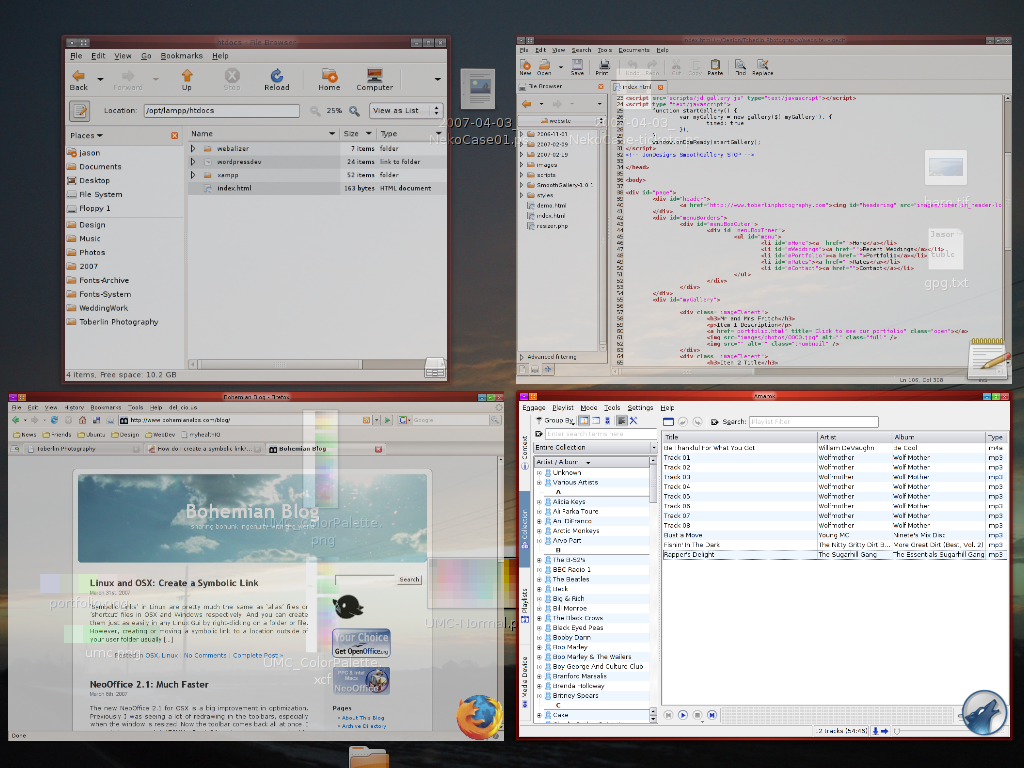
I posted a while back about ‘Skippy’ for acquiring that OSX Expose goodness in Linux. Well, since then I’ve had the luxury of using Beryl for about a month. It’s got a few bugs since it’s still developing, but very usable. Some of it is just eye candy, but things like the minimization of all of my active windows so I can find the one I’m looking for is very helpful. I use Expose a lot at work on OSX 10.4 and so having it at home makes for excellent consistency. Here’s a great video of every feature I can think of:

Beryl on Ubuntu via YouTube

And here a few screenshots from my desktop.

Application Switcher
Beryl-AppSwitch

Expose-ish
Beryl-Expose

Desktop Cube
Beryl-Cube

I hope you enjoy the pictures. I’m certainly enjoying the experience.

Linux and OSX: Create a Symbolic Link

‘Symbolic Links’ in Linux are pretty much the same as ‘alias’ files or ‘shortcut’ files in OSX and Windows respectively. And you can create them just as easily in any Linux Gui by right-clicking on a folder or file. However, creating or moving a symbolic link to a location outside of your user folder usually involves being the ‘super user’ or using ‘sudo’. It’s so simple to do with the Terminal, I can’t see trying to work around within the gui. So, I hope you find this helpful.

I found this info here thanks to a good friend:

http://help.hardhathosting.com/question.php/95

It’s such a good note to keep around that I wanted to have it on my own site.

In the Terminal enter the following:

ln -s [TARGET DIRECTORY OR FILE] [SHORTCUT]

For example:

ln -s /xampp/htdocs/work /Users/username/xamppwork

This points a symbolic link located in your home folder (xamppwork) to “/xampp/htdocs/work”

I am finding this to be very useful for using XAMPP to develop dynamic sites or to work the bugs out of WordPress themes. I have my working folder inside my Documents directory and then place a symbolic link to that folder inside the XAMPP server’s ‘htdocs’ directory. Pretty slick.

NeoOffice 2.1: Much Faster

The new NeoOffice 2.1 for OSX is a big improvement in optimization. Previously I was seeing a lot of redrawing in the toolbars, especially when the window is resized. Now the toolbar comes back all at once. I upgraded my parents’ 450MHz Dual G4 and noticed a considerable improvement. I’m looking forward to seeing the difference on my fiance’s PowerBook G4 400MHz.

It’s still in the ‘Early Access’ stage, so you will have to give them some money to get it, but it’s a great tool and definitely worth supporting. Here’s the site:

www.neooffice.org

Internet Explorer 6 and 7:Mess Up WordPress Image Uploads

I just ran into a problem on a photo site I have made with WordPress. The photo site is a photo web log where there are multiple authors that contribute one photo at a time (or so I prefer!). I don’ t know how to edit WordPress’s setup so that the upload process creates an image to a custom width rather than the default thumbnail. With that in mind, every author has to click ‘Write Post’ and then upload their pre-sized to 500px wide image to the site. From there they have to click on the ‘upload’ menu’s preview of their image. The one click brings up a menu on top of the photo that looks like this:

  • Using Thumbnail
  • Not Linked
  • Send to Editor
  • Delete
  • Close Options

If you click on any of the items they will toggle to another option or execute the stated function. In my photo site’s case we change it to the following:

  • Using Original
  • Not Linked
  • Send to Editor
  • Delete
  • Close Options

Then we press ‘Send to Editor’ and an img tag is sent to the Editor with the correct settings. Everything is as it should be (except that it excludes dimensions and that agitates the standards-loving person that I am, but I let it slide for the sake of ease of use). However, when using Internet Explorer 6 or 7 something funny happens.

  1. The ‘width=’ option IS being used, but without quotes around the contents (the same for the alt setting) and it’s set to ’96’ which is basically the thumbnail width.
  2. The file path to the ORIGINAL is provided in the alt specification while the src specification remains pointing at the thumbnail file.

My friend was banging his head against the wall trying to figure it out. Once I discovered this problem I simply suggested that he install Firefox. ๐Ÿ˜€

In conclusion, I don’t know a lot of people that use WordPress in this way, so maybe it isn’t very well known. Maybe it has something to do with my theme, but that shouldn’t be the case, since it’s within the admin side of the site. Anyway, maybe this write up will save somebody a headache.

OSX Exposรฉ for Linux with Skippy

Expose on Linux with Skippy 01

Like any OSX-turned-Linux user, I’ve been missing certain features. The most obvious one is definitely Exposé. At work I’m still using OSX 10.4 with the scroll wheel-click set to invoke Exposé. I have a LOT of windows open plus I have a dual monitor setup, so it’s even worse. Exposé really shines in that situation. Generally, however, I find myself more focused when at home on my good-as-new-used Thinkpad T42 running Ubuntu Edgy. I don’t have anywhere near as many applications running, but that feature seems like it should be there, especially when I have my Logitech MX310 multi-button mouse plugged in.

Last night I found myself getting that I should be installing cool new software instead of doing my work itch. It’s a bad habit that I can only guess plagues many Linux noobs after the long journey of installing every cool free software they can dream of and customizing their desktop to their very exceptional taste. I think it comes out of having almost no such options on commercial operating systems. The software is usually very expensive (though there’s a lot of open-source stuff available lately) and customization is fairly limited. So I started searching for something resembling the title of this post. I found three items with supposed similar functions for Linux:

I would love to have tons of data on all three, but I don’ t have time right now. It looks like Expocity was a Metacity hack and maybe it didn’t work that well. I can’t find much info on it. Kompose is supposed to be very nice, but is for KDE. Granted, I use a lot of KDE applications already on my Gnome desktop, but they have their share of quirks and something like Kompose is very intertwined with the KDE desktop and Qt. Kompose looks pretty sweet. Yet another reason for me to switch to KDE.

Skippy wins by default. The brief research I did on the matter lead me to a blog mentioning that Skippy could be installed in Ubuntu with Synaptic. Shit man, that’s all you had to say!

Expose on Linux with Skippy 02

So off I went to Synaptic. It’s that easy. There is no gui management program though. All you need to know is that F11 invokes it to do its thing. I guess that could cause problems with some applications, but I don’ t use my F11 key much at all. Apparently there should be some kind of config file in your home directory called ‘.skippy’ or something similar. My system does not have that to my knowledge and I’ll be damned if I go looking through the entire filesystem searching for it. F11 is fine.

I did have to go to the Terminal and enter ‘skippy’ to get it running. Open a terminal, type ‘skippy’, press enter and then see if pressing F11 invokes a display of all of your open windows in a grid like the screenshots shown here. Once that was figured out, I went to System Preferences/ Sessions and added the command ‘skippy’ to my startup programs. Et Voilá!

To summarize: install Skippy via Synaptic, activate skippy via terminal and set skippy as a startup application from within the System Preferences/ Sessions dialogue.

Caveats: If you use Firefox with tabs, get ready to be disappointed. Apparently skippy takes an initial snapshot of one of the pages and that’s that. Doesn’t matter which one you have active at the moment. Skippy is damn near perfect with full display-filling windows, but small windows effectively get used as part of the preview of whatever window was behind it. I even had a moment when my spreadsheet window was actually represented by an image of a web browser showing a web site.

Now if only I could map one of my unused mouse keys to the F11 key. If I can figure THAT out, I’ll have something to talk about.

Migrate Thunderbird from WindowsXP to Linux or OSX

Using Mozilla Thunderbird over other email applications is mostly a matter of preference. However, the fact that it is an application that runs on Windows, OSX and GNU/Linux is a very big reason for using it rather than other similar applications. Not only is it running on these operating systems, but it is extremely easy to move your mail and all of your settings to another computer and/or operating system.

I discovered this after temporarily moving one of my sisters onto my G5 after her Windows machine stopped booting. I was able to use the Ubuntu 6.06 live cd to access her hard drive and copy all of her important documents to my iPod Mini.

The files you need to retrieve from the Windows PC are in the following directory:

Documents and Settings/
<username>/Application Data/Thunderbird/Profiles/xxxxxx.default/

These are the files you need from there:

Address Book: abook.mab
Preferences: prefs.js
Mail: Mail (folder/directory)

It is probably also a good idea to go to Address Book while in Thunderbird and export your addresses to one of the more universal formats like ldif or csv. I won’t make any promises if you try to import them to another email application, but you can at least open those with a spreadsheet application if all else fails.

Keep those files in a safe place or back them up along with anything else that’s important to you. Now go to the new machine or go ahead and install another operating system, whatever. On the new system install Thunderbird and then load it and walk through the account set up with some dummy info. I do this so that when I go into the directory to find the place for my old files to go there’s something there for me to replace. It also reaffirms that I am putting them in the right place.

Close Thunderbird after you finish the account set up. In your file browser find your Thunderbird files. Following are locations for those files in different OSs to the best of my knowledge:

OSX:
HD/Users/<username>/Library/Application Support/Thunderbird

Windows:
C:/Documents and Settings/<username>/Application Data/Thunderbird

Ubuntu:
/home/<username>/.mozilla-thunderbird
(Most Linux OSs will be similar. Note that .mozilla-thunderbird is a hidden file. In most Linux file browsers there is an option under ‘View/Show Hidden Files’.)

Okay, now all you have to do is copy your old files to this directory and in doing that you will replace or overwrite the existing files:

Address Book: abook.mab
Preferences: prefs.js
Mail: Mail (folder/directory)

Once that is done, load Thunderbird and it should look like you never left home!

I am offering these instructions to be helpful. By attempting to do this you are accepting all responsibility for the outcome. I cannot guarantee success. Make sure that you take notes on any information regarding access to your mail servers and accounts before deleting your existing Thunderbird set up.

Force Quit in Linux

I had a listing a while back for some key commands in Linux. Since my recent move to Ubuntu 6.10 I have discovered that Ctrl-Alt-Esc does not bring up the trusty old skull and crossed bones. A listener tip on the Linux Reality podcast pointed out this little trick for force quitting an uncooperative application/program:

open a terminal and type the following and press enter: xkill

Apparently this changes your cursor into the familiar skull and crossed bones. Then simply click on the window of the application/program that you wish to force quit or kill.

Internet Explorer 7 and RSS features

Okay, IE7’s implimentation of RSS is basically a built in aggregator. That’s actually pretty nice. However, only dorks are going to know how to get there. So, nice try Microsoft. There is no comfortable way to ease people in to RSS. Firefox doesn’t have a built in reader, but I prefer the way they use the features of RSS to create a more dynamic web experience.

To start, IE’s setup is pretty familiar. If you are on a site with an RSS feed the little RSS icon lights up in a familiar orange. One thing I like about the set up is that the RSS icon is always present on the top bar in IE7. If there isn’t anything available it turns blue like an inactive feature. Very nice. So, you either go to that menu when it’s active or you click on a link in the page to is linked to the RSS feed. You are then presented with a page similar to Firefox. There’s an information block on top explaining what you are doing and it is followed by the contents of the feed. Great. Yes, please add this to my Favorites/Feeds list.

That’s where it goes bad. I just added to my Feeds list, but where the hell is my Feeds list? So figured out how to get the menu bar back, but then there wasn’t anything referring to my Feeds under ‘Favorites’. Wha? Where is it? So, I go back to the ‘house icon menu’ and discover that Favorites/Feeds is listed there and then a familiar favorites list including my Feeds pops up on the left of my browsing window. This is nice. A built in aggregator. Great for reading feeds without going to the sites. But I prefer Firefox’s dynamic links. That’s just me.

That’s all I’ve got to say. Chances of middle aged women using RSS within the next two years? Not very good.

Also, what’s up with the ‘no menu bar unless you request it’ stuff? Now people will never start to learn. Good thinking guys! I had to putter around through the ‘house icon’ menu to discover that I could even turn the old-style menu back on. My parents would be done.

Linux Filesystem Info

I was listening to the podcast ‘Linux Reality’ via iTunes while I was working late this week. There’s some great stuff for Linux noobs. I definitely still fall into that category. The episode on the Linux file system had a lot of info I don’t want to forget.

OSX seems to be similar to Linux as far as the file system goes, but it is certainly much easier to understand by the average person. If you have ever made it so that the Finder shows you all of the hidden files in OSX, you know that Apple hides a lot of folders and files from their users. I found it disappointing. OSX has an illusory feeling to me now. More like a satin sheet covering the gears and pistons of a very complex machine. I have always disliked how Windows hides things from its users, but now I realize that Apple simply does a better job of keeping the wizard’s curtain closed. Here’s a quick break down of a generic Linux file system:

  • bin : Binary
    • Some programs that are used by all users
  • dev : Device
    • A virtual directory that contains folders that represent your computer’s hardware
  • etc : Etcetera
    • Configuration settings for programs
  • home : Home
    • Directories that contain each user’s documents and preferences
  • lib : Library
    • Shared libraries used by some programs
  • mnt : Mount
    • media drives are represented here (sometimes a directory named ‘media’ is used instead)
  • opt : Optional
    • optional programs, testing programs, additional programs
  • proc : Processor
    • A virtual directory containing system hardware information
  • root : Root User Home
    • root user’s home directory
  • sbin : Secure Binary
    • programs used by administrative users
  • temp : Temporary
    • Temporary information is stored here. Temporary means for the duration of time between boots in most cases.
  • usr : Unix System Resources
    • Shared data, images, libraries and applications are found here. You will find program icons here for instance.
  • var : Variable Files or Data
    • log files, databases for websites, etc

The person responsible for the Linux Reality podcast is Chess Griffin. There are many episodes already available. Here’s his site: www.linuxreality.com

Too Much Spam

I have recently been getting hit with waves of spam. I’m tired of dealing with it, so I have made registering mandatory for anyone that wants to comment. Most of my content is more informative, so I would say that comments are all that common. However, if anyone has corrections or something to add, please take the time to register. Thanks for reading the blog. I have a good-as-new-used or ‘Refurbished’ Thinkpad T42 being shipped to me via UPS this week, so some new posts on that machine should be popping up.

Ubuntu 6.06 on 1.6 GHz PowerMac G5 (part 3)

The first thing to do with Ubuntu on a G5 is reconfigure the X server. By doing this you will be able to expand your allowed screen resolution from 1024 x 8XX to 12XX x 1024 or possibly 16XX x whatever. This was a big issue for me. 1024 is just not big enough.

When doing this make sure you know your G5’s video card and model (my 1.6 GHz G5 has nVidia GeForce FX5200). There are plenty of questions within the set up process where you will simply give the default answer because you don’t know what the hell they’re talking about. If the question sounds over your head, just relax and most likely there’ll be some helpful notes there for you. Open a terminal and enter the following to begin the set up:

sudo dpkg-reconfigure xserver-xorg

After that’s done it’s pretty much business as usual. There are a few sacrifices. The G5 is fast, but I think the video card isn’t being used to it’s potential by Linux. When the screen saver that looks a lot like the standard OSX colored-flare screen saver comes on, it seems to work the machine pretty hard. In fact, any of those more dynamic screen savers run a bit choppy. The G5 should have no problem with those things, but that’s truly the least of my concern.

The other issue is that of sitting at a Mac with a Mac keyboard but not being able to use the ‘Apple’ key like you used to. There is a lot of room for custom key commands, but Linux looks at the Apple-keys as two separate buttons rather than two buttons with the same function. So, the left key can be set up differently than the right key. It makes one wonder about the use of the control key. Well, the location of the control key anyway. The Apple key location makes so much more sense. It’s definitely more ergonomic.

For the record, I plan on reinstalling OSX and selling my G5. I want a Linux-only system and the G5 (with my limited Linux and programming capabilities) is just not the easiest machine to use. There is also the fact that I want a laptop, so my perspective might be distorted. My assessment is similar to others: If you have a Mac, run OSX. There are some things about OSX that I don’t like and there are some things about Linux that I like, want to learn more about and promote. The day the GIMP supports CMYK will be the nail in the coffin for me, but until then I’m going to try hard to make designing for print and the web in Linux work.

Open Source Applications on OSX for Graphic Design and More

This is for people using OSX, but a lot of these are ported to Windows. Actually, in Windows you can get true, native apps, while in OSX you have to use the X11 emulator most of the time. Regardless, here’s a few tidbits that might make open source more attractive and easier to acquire.

X11
X11 or simply ‘X’ predates all of the operating systems us laymen are familiar with. It is the original graphical user interface. When young Steve Jobs went over to Xerox Labs this was what caught his eye (yes, Xerox invented the mouse, if you didn’t know). It started on Unix machines, was adapted slightly for Linux and now you are running an emulator within OSX. OSX install disks come with this since 10.3. If you are doing a fresh install, it’s under the ‘Customize’ button that appears shortly before the ‘Install’ window. Just check a box. Otherwise, you can install it after the fact, but I’m not going to describe that here. If you are using 10.3 there is a download on Apple’s site. Apparently for 10.4 they recommend installing from your original disks. You MUST have this to run the following unless otherwise stated.

GIMPshop
The only thing the GIMP (Gnu Image Manipulation Program) lacks is CMYK support and Layer Sets. Okay, that’s not the only thing, but it’s pretty close to Photoshop 6, and that’s not bad. There is a variant of the GIMP out there that targets Photoshop users. This brilliant individual changed the menues, tool shortcuts and some of the graphics to make the GIMP look and feal more like Photoshop. Google ‘gimpshop’ and download. If you already have X11 installed, installing and using GIMPshop is like using a native application.

FINK
This is cool, but difficult to understand if you are not familiar with Debian or Ubuntu Linux. It’s an application that downloads and installs applications for you. Specifically *NIX applications. It allows you to avoid ‘Dependency Hell’. If you don’t know what that is, revel in that fact. To get Fink, go here: http://fink.sourceforge.net. It installs like a standard application. After that’s installed you’ll want to drop the application ‘Fink Commander’, which comes with Fink, into your applications folder. Follow their instructions. Once that’s all done you can use Fink Commander to review the list of available applications. The GIMP is available this way, but it’s a much older version, so use the above suggestion instead. The next few apps can be installed through Fink. You will have to add any X11 applications installed through Fink to your X11 Applications menu manually, but if you want to know more about that, just ask. To install apps, open Fink Commander and browse the list or use the search feature to look for what you need. When you find the right file, highlight it and click the button on the far top-left. Fink will take it from there.

Scribus
This is a layout application. It’s a little rough around the edges, but worth checking out. I can’t find a kerning function, but it can be a powerful app. The best feature about Scribus is that its document files are actually written using xml. This means that the file can be opened by a text editor and edited. Maybe that doesn’t sound sexy, but it allows you to manage the content more like a web page. Granted, the markup can get complex and messy, but it’s much more future-proof than the closed binary proprietary file formats tha the commercial apps use.

FontForge
Like the name indicates, this application allows you to create or customize your own fonts. Sounds like fun, but in reality is fairly complex. Great tool though. Can also be used to convert PC fonts to Mac fonts and vice versa (so I’m told). A handy tool to keep around. Installs through Fink easily. I’ve successfully created a font with only the first 6 letters finished. It’s cool if you have a little patience.

KDE Games
Okay, not a design tool, but who doesn’t need a little old-school gaming action every now and then? Here’s a few of the games included: Battleship, Poker, Solitaire, Tetris, Connect-4, Putt-Putt Golf (and you can make your own courses! Killer!), Black Jack, Mahjongg, Minesweeper, Tron and Asteroids. Just use Fink Commander to search for ‘KDE Games 3’ and click the little (less than intuitive) button in the top-left to install. The files don’t have little sexy icons though. You will find the files (after you install them) here: /sw/bin/. I’ve found that OSX doesn’t recognize these as applications, so you can’t make a shortcut for your doc by right clicking. However, if you make a shortcut for a native OSX app and then Get Info, you can change where it points to. So, take that shortcut and name it after one of your new KDE games, and then point it at the appropriate binary file in /sw/bin.

Inkscape
Inkscape is a pretty solid vector drawing application. It’s documents are an svg file type and that means written in xml. Sound familiar? SVG is the W3C standard for vector graphics. Which is why SVG stands for Standard Vector Graphics. Unfortunately, you can’t install Inkscape via Fink. However, it’s easy enough to download and install by going here: http://www.inkscape.org/download/?css=css/base.css from there you can download the OSX version. It will work pretty much like the GIMP, which is pretty much like a standard OSX native app.

Well, there you have it: A complete graphic design suite. If only Adobe CS came with Asteroids! There are endless amounts of apps out there, but I need to get some sleep. Let me know if any of this interests you or if you have something to add to the list of information.
Ubuntu 6.06 on 1.6 GHz PowerMac G5 (part 2)

Well, I finally got to a point where my OSX installation wasn’t doing a lot of work for me. As I have said in earlier posts, I have an Ubuntu 6.06 disc (see part 1) and a good friend with cable internet downloaded all of the Yellow Dog 4.1 discs for me after my failed attempt over dsl.

I have booted from the Ubuntu cd before, but was disappointed with the screen resolution topping out at 1024 x 840px. That wasn’t acceptable. So I started with Yellow Dog. Yellow Dog specifically makes Linux for PowerPC processors. With that in mind, I figured the video hardware they needed to support would be a fairly short list. They should be able to keep track of the very few video cards that Apple uses right? I guess they support other PowerPC computers, but for the general consumers Apple Computers and Microsoft’s Xbox are pretty much the only available PowerPCs on the market.

For starters I used the OSX install disc to boot and used the Disk Utility from there to erase my current 74GB OSX partition (along with some files I forgot to back up) and set a new OSX partition at 20GB while leaving the rest of the disk empty. I set the OSX partition at the end of the disk since I intended to install Linux on the front. I can’t say if the partition order really matters.

I installed OSX in its new 20GB home. I then booted from the Yellow Dog 4 disk. Anyone familiar with RedHat will find YD’s Anaconda installer pretty much unchanged. It is a great installation experience and definitely gives you confidence that this will work :). I think I did a ‘Workstation’ install, but after I did some manual editing of the application list, that might have all gone to hell. The installation went fine and on rebooting I had a boot option for OSX. Very easy and straight forward.

Problem number 1: Screen Resolution
I don’t understand the difficulty here, since my G5 is already two years old, supporting the hardware shouldn’t be difficult. However, the 1024px cap that I experienced in Ubuntu was there in YD. I attempted to alter the resolution from the ‘Display Resolution’ application as well as altering /etc/X11/xorg.conf but to no avail. I successfully changed the setting at one point only to find myself without a display. So it wasn’t really successful. Fortunately, I remembered the Control-Alt-Backspace feature for restarting X11 and it walked me through correcting the problem. So back to 1024. ๐Ÿ™

Problem number 2: Dual Monitor/Head Support
At that point I had also discovered YD’s ‘Display Resolution’ had a tab for dual-head or dual-screen set up. That’s pretty cool and definitely looks as simple to manage as OSX’s. Unfortunately, it didn’t jive well with the fact that my single video card had the ability to output two displays. In the error log I noticed an error stating that it was sending the data to a device already in use. So, it is likely that with two physically separate video cards this would be a snap. Alas, but not for me. ๐Ÿ™

Problem Number 3: I Hate RedHat and RPMs
Looking at my brand-spanking-new desktop was not inspiring. I was starting to remember why I had a bland response to my initial Linux install all the way back two years ago: RedHat’s main menues are sloppy and confusing and the RPM system sucks if you don’t know where to get dependencies (this state of mind is called ‘Dependency Hell’ for any of you that are newer to this than me). I realize that I can customize the menu, but I don’t want to do that and there are so many applications that seem to have similar names or would do similar things that it just doesn’t seem worth it. When I first used XFCE I was amazed how the makers took the time to group all of the System Setting applications into one dialog box. What a novel idea! KDE should get some credit for that as well, but KDE just isn’t quite my cup of tea. XFCE, for all of its limitations and faults, is a great desktop environment for people coming over from Windows and OSX. I think XFCE has even out simplified Apple. But anyway, RedHat’s implimentation of Gnome is simply revolting. Ubuntu has them beat with a much more organized menu from the start. I think the way Synaptic makes installing applications easy is the other important feature. Not much learning required. And so, Yellow Dog failed to meet my expectations. ๐Ÿ™

My next move was to install Ubuntu instead and see how the dice rolled. I had already screwed my OSX installation, I might as well try everything now. I started from scratch, erasing the whole disk and reinstalling OSX. Why? Because OSX, though it shows you one nice and simple partition, is actually creating two or 3 small partitions additionally that contain boot instructions for OSX (the equivalent of a Master Boot Record, I assume). From what I understand, the linux distros have to write to one of these specific partitions in order to alter the boot options. Actually, I did initially try to install Ubuntu right over the YD 4, but when it came time to reboot I did not see the boot option text. It booted straight into Ubuntu. No OSX. So, I went back and started from the beginning.

This is getting long, so I will finish up in a PART 3 soon.

Server Side Includes: The Most Important Single Thing to Know

Includes, includes, includes. You can learn everything else later.

  1. ColdFusion: <cfinclude template = “includes/header.htm”>
  2. PHP: <? include(“includes/header.php”) ?>
  3. ASP: <!––#include file =”includes/header.inc”––>

Of course, each of these should be used within files that have the appropriate extension. The appropriate extensions are .cfm, .php or .asp respectively. Another assumption on my part is that you already have one of the appropriate server applications running to make sense of either of these.

What the hell is an ‘include’? I’ve spent some good amounts of time trying to find just these very simple include ‘tags’. The first hurdle is understanding the concept of an ‘include’. An include can insert the content of a specified text file in place of itself much like an ‘img’ tag replaces itself with an actual image or photo on screen. However, the include tag is part of a script, not part of the xhtml markup. If you look at the source of a ColdFusion, PHP or ASP web page, you won’t find any ‘include’ tags. When the file is received by a browser application it appears to be a normal html file. The advantage of this belongs in the realm of what most Dreamweaver or FrontPage web designers know as ‘Templates’. Only these are much better, because the server handles all of the updating if you make changes to parts of the template (and none of that stopping-you-from-editing parts-of-the-page crap). It’s simple: Your site’s top navigation is one file that is included into the top of every other page of your site dynamically. Updating your navigation no longer means copy/pasting your navigation markup into several or hundreds of separate html pages. Just update the one, single file. All of this is accomplished without buying a fancy Content Management System. Beautiful.

After you get comfortable with these you can always move on to the more complicated applications of these server side script languages. This one single element is huge though. To me, it brings the original meaning of PHP to mind: Personal Home Page. You don’t have to be an html guru to comprehend the impact these tags have on website management.

Please let me know of any other simple but powerful uses for any of these server-side script languages.

Ghetto iPod Blaster

Ghetto iPod Blaster

I’ve been using these for about a year now as speakers for my iPod Mini. I was painting a mural for a few months and recently I’ve been painting the interior walls of a house I’ll be renting. These old PC speakers beat the holy hell out of dragging CDs around or buying one of those overpriced iPod jukeboxes. I wouldn’t want to leave one of those in my car trunk through the winter or get paint on them. I don’t know about the quality of the sound (they are a bit ‘tinny’), but they sure do work in a pinch. It’s so simple of a concept that I won’t go into details. The picture says a thousand words. ๐Ÿ˜€